Jewell Projects
Steadfast
Information Memorandum – an Australian-first separation intelligence system
| Engagement | Steadfast – Separation Support AI (working title) |
|---|---|
| Status | v01 draft – commercial terms not yet settled |
| Audience | Prospective investors and strategic partners, by invitation |
| Date | 2 September 2026 |
| Supersedes | n/a – first issue |
| Prepared by | Jewell Projects |
Confidential
This memorandum is provided on a confidential basis for the sole purpose of allowing the recipient to evaluate a potential investment in the project described. It is not an offer to sell or a solicitation of an offer to buy any security, and it is not a disclosure document, product disclosure statement or prospectus for the purposes of the Corporations Act 2001 (Cth).
Nothing here is financial product advice. It has not been prepared having regard to any recipient’s objectives, financial situation or needs. Statements about future performance are forward-looking and subject to risks outside the project’s control. Recipients must make their own enquiries and obtain their own legal, tax and financial advice.
Figures shown as to confirm are not yet settled and must not be relied on or circulated as though they were. By reading further, the recipient agrees not to reproduce or distribute this document without written consent.
01Purpose and status
This memorandum describes what Steadfast is, what has been built and independently verified, and what remains open. It is issued in draft because the commercial terms have not been set.
Every product, architecture and verification claim in sections 03 to 10 is drawn from the working codebase and its committed verification record, not from a plan. Where the source is a live test against a deployed environment, the memorandum says so and gives the date.
The commercial sections – market, model, route to market, team and the raise – are deliberately incomplete. Rather than fill them with plausible numbers, each unsettled figure appears as a marked slot. Section 19 lists every one of them in a single table, so the gap between this draft and a document fit to send is explicit and finite.
How to read this
Sections 03–10 are evidence. Claims are traceable to code, migrations, tests or a dated live run.
Sections 11–18 are position. The argument is settled; the arithmetic is not. to confirm means the founder has not yet supplied the number.
Section 19 is the to-do list. Close it and this becomes a final memorandum.
02Executive summary
Steadfast is a private, persistent companion for Australian men in the first twelve months after a separation. It is not a chatbot. It is a separation intelligence system: it listens, remembers, keeps facts apart from allegations, watches for risk, maintains a chronology, coaches communication under pressure, and always knows the single next move that matters.
The position in six points
- The market is underserved by design. Separated men are a demographic that does not present, does not ask, and does not talk. The information they need exists, scattered across government sites and legal FAQs, and none of it knows their situation or remembers what they said yesterday.
- The product is a system of record, not a conversation. Everything said becomes structured case intelligence – a live map across seven dimensions, a dated chronology, classified facts, and one Next Best Action. Value compounds with use; a generic assistant starts from zero every session.
- Privacy is the architecture, not a policy page. Row Level Security on every table, the server holding no privileged data path, Sydney-region storage, on-device speech, and an AI gateway instructed never to retain a prompt. In this category that is the product, not a feature of it.
- It is built and verified, not specified. All seven build phases are complete and exercised end to end against a deployed environment with real model calls – including the safety behaviour, the isolation guarantees and the professional handover pack.
- It makes professionals more effective rather than competing with them. A client who arrives at a family lawyer organised, dated and evidenced is cheaper to serve and better served. That is the distribution channel and the credibility test at the same time.
- The commercial case is the open work. Pricing, sizing, unit economics and the raise are unsettled. Section 19 says exactly what is missing.
Can a newly separated bloke spend ten minutes with this and leave calmer, clearer about his situation, and knowing what he should do next?
The primary success test, from the product principlesThe ask
Steadfast is seeking to confirm – amount at to confirm – stage and structure to to confirm – the one sentence on what the money buys. Use of funds is set out at section 17.
03The problem
When a relationship ends, everything arrives at once, and it arrives at the worst possible moment for clear thinking.

Where the children sleep tonight. Who stays in the house. What that letter from a lawyer actually means. How to answer a message that made his blood boil. Whether the thing he did last Tuesday has made his position worse. Each of these is answerable. Together, in the first weeks, they are not.
Why the existing options fail this person
The cost of the gap
The damage in the first twelve months is largely self-inflicted and largely preventable: the message sent in anger that becomes an exhibit, the arrangement agreed verbally and never recorded, the appointment attended with nothing written down, the escalation that could have waited a day. None of it requires legal knowledge to avoid. It requires someone steady in the room at the moment of the decision.
Steadfast is built to be in the room at that moment.
04The product
A single private companion that turns an unstructured account of a separation into an organised, current, defensible picture – and then tells the user the one thing worth doing next.
The core loop is deliberately narrow: chaos → clarity → priority → action → continuity.
| The user’s test | The surface | What it does |
|---|---|---|
| It understands me | Talk | A streamed conversation that asks one or two natural questions at a time rather than running an intake form. Coverage of the seven intake topics is tracked silently behind it. |
| It remembers me | What I know about you | Typed, inspectable memories the user can correct or delete. He never re-explains the basics on return. |
| It makes sense of my situation | My Situation – the Separation Map | Seven dimensions – children, communication, legal, money, home, wellbeing, support – each held at one of four priority levels, and defaulting to Unknown until something establishes otherwise. |
| It stops me making things worse | Don’t Send This Yet | He pastes the message he is about to send. It classifies the risks with excerpts and returns a calm, factual, child-focused rewrite he can actually use. |
| It tells me what to do next | Next Move | One action, with the reason it matters now – and the honest answer when the right move is to wait. Superseded, never overwritten, so the history is auditable. |
Don’t Send This Yet, in practice
A fictional exchange, written for this document. No real person’s words appear anywhere in this memorandum.
“You know exactly what you did. You’ve turned the kids against me and everyone can see it. I’m done being reasonable – my lawyer will be in touch and you’ll be explaining yourself to a judge.”
“I’d like to sort out this weekend’s pick-up. Can we confirm Friday at 5pm at the usual place? If that doesn’t work, tell me what does and I’ll make it fit.”
The system also names why: threats of legal action used as pressure, characterising the other parent to the other parent, and putting the children inside the dispute. It does not lecture, and it does not send anything – the user does.
The rest of the surface
- Timeline – a dated chronology built from what he says, each entry proposed for him to confirm, edit or ignore, and worded “user reports…” until it is established.
- What Just Happened – a mode for the hour after an incident, when he needs to get it down before he loses the detail.
- Professional Prep – an eleven-section pack for a lawyer or mediator appointment, keeping facts, reports, assumptions and unknowns visibly apart, with his questions framed as questions rather than conclusions. Print-friendly.
- Safety – a dedicated layer, not a prompt instruction. Where the situation is urgent, coaching stops and crisis contacts surface.
- Support near him – a state-aware directory of crisis, mental health, family violence, legal aid, community legal, family relationships, parenting, child support and court services. Thirty-seven entries across the eight states and territories and nationally, readable without an account, tap-to-call, and carried into the companion’s own context so it can name the right service and the right number in one sentence.
- Voice – dictation transcribed on his own device. The audio never leaves it.
05How it actually works
The difference between this and a well-prompted assistant is that the conversation is not the product. The conversation is how the product collects its inputs.
Two brains, one experience
Each turn runs two separate functions against the same message. The conversation is streamed, warm and human. The case assessor runs behind it, structured and validated, extracting memories, chronology entries, priority changes and safety signals. They may share a model. They never share a prompt, because the qualities that make a good reply are not the qualities that make a reliable extraction.
The AI proposes; the application decides
No model output is trusted as an instruction. Every structured result is validated against a schema; a failure gets one correction attempt and is then discarded rather than applied. What lands in the case record and what becomes the Next Best Action are decided by ordinary deterministic code. The model is a very good reader of an unstructured account. It is not the system of record.
Facts are classified, not assumed
Facts, user reports, allegations, assumptions, professional findings and unknowns are six distinct classifications, enforced at the schema and database level rather than in wording. An accusation can never quietly become a fact through repetition. This is what makes the professional handover pack usable by a lawyer, and it is the single hardest thing for a general assistant to retrofit.
The context has a hard ceiling
Seven deterministic layers – profile, current situation, relevant memories, significant chronology, priorities and next action, recent conversation, and reviewed Australian knowledge – are assembled to a character budget per layer and a total cap of 22,000 characters, roughly 5,500 tokens. The prompt cannot grow unbounded no matter how long the case runs. That is a cost control, a latency control and a prompt-injection ceiling in one decision.
06Product principles
Eight rules treated as architectural requirements rather than aspirations. Where an implementation choice threatens one, the principle wins.
- Children before winning. No adversarial coaching for its own sake.
- Safety before strategy. Immediate safety concerns override ordinary coaching, through a dedicated layer rather than a prompt suggestion.
- Responsibility without judgement. The user is not automatically right; the former partner is not automatically wrong.
- Action before information. One next best action, never a ten-point list.
- Personalised before generic. Advice sharpens as the structured case grows.
- Professional bridge, not professional replacement. It makes people dramatically better prepared to use professionals.
- Facts are sacred. Six classifications, enforced in the schema.
- Unknown is a valid answer. Every map dimension starts unknown. No manufactured certainty.
These principles are also the commercial position. A product for this user in this moment earns trust slowly and loses it instantly. Every one of the eight is a decision to be less impressive in a demo in order to be more usable at 11pm on a Tuesday.
07Technology and architecture
A small, modern, low-operational-burden stack chosen so that a team of this size can run it, and so that no single supplier can hold the product hostage.
| Layer | Choice | Why |
|---|---|---|
| Client | React 19, TypeScript, Vite – mobile-first | The user is on a phone, often late at night, often on poor reception. |
| Edge | Cloudflare Workers with Hono | No servers to patch, global by default, and the deployment story is one command. |
| Data | Supabase Postgres 17, Sydney region, RLS on every table | Australian residency and per-row isolation enforced by the database, not the application. |
| Model | Anthropic Claude behind a model-agnostic adapter | Model identifiers are configuration. Swapping provider is a config change, not a rewrite. |
| Model transport | Cloudflare AI Gateway, payload logging disabled | Cost, latency and failure telemetry retained; prompts and replies never retained. |
| Speech | Whisper running in the browser | Dictated audio is transcribed on the device and never uploaded anywhere. |
| Validation | Zod schemas on every structured model output | Malformed or manipulated output is rejected rather than written to the case. |
Three decisions worth an investor’s attention
08Privacy, security and residency
This product holds what a man tells nobody else, in the weeks he is least able to protect himself. Privacy is not a compliance exercise here. It is the reason he opens it at all.
| Control | Implementation |
|---|---|
| Isolation | Row Level Security on every table exposed through the data API, with per-command policies and write checks so a row can never be created for, or reassigned to, another user. |
| Residency | Postgres 17 in ap-southeast-2 (Sydney). Australian data stays in Australia. |
| Anonymous start | A visitor can begin with no email at all and claim the account later. The first thing the product asks for is not his identity. |
| Model privacy | All model calls are server-side and pass through a gateway instructed not to retain payloads. The gateway keeps latency, tokens, cost and status; it never keeps what was said. |
| Speech | Transcription runs on the user’s own device. An earlier implementation using the browser’s built-in speech service was removed because it streamed audio to a third party. |
| Cross-border processing | Stated rather than buried: to produce a reply, what the user writes goes to the model provider in the United States, through the gateway described above. Everything else – the case, the chronology, the memories, the account – stays in Sydney. The privacy promise and the consent screen both say so in the user’s own words, and list his rights under the Australian Privacy Principles including the OAIC. |
| Telemetry | Conversation content never enters analytics, error tracking, console output, server logs or request tracing. Errors are sanitised to a class, a coarse category and a correlation id, because an error message can quote the user. |
| Audit | Audit records store event types and entity identifiers only – never content bodies. |
| User rights | Complete JSON export of every table, and irreversible account deletion that cascades every row. Memories are inspectable, correctable and deletable. Consent records are immutable and versioned. |
| Abuse controls | Captcha on anonymous sign-in, a per-minute burst limiter and a durable hourly quota counted from insert-only audit rows rather than a resettable table. |
| Browser hardening | Content Security Policy, framing denied, no-referrer, restrictive permissions policy, and self-hosted fonts so that no third party learns which address loaded the site. |
Verification
Two-user isolation was first proven at the SQL level – nine checks of nine passed – with zero findings from the platform’s own security advisors, and the check is repeatable as an automated suite.
That check was allowed to go stale once, when attachments were added, and the project recorded it as stale rather than quietly continuing to cite it. It was re-run against the live database on 2 September 2026: all seventeen tables carry row-level security with per-command policies keyed on the caller’s own identity, four tables deliberately have no update policy at all, and the file storage policies are each scoped to the caller’s own folder. Account deletion removes stored files before the user.
Regulatory posture
The product handles sensitive information under the Australian Privacy Principles, and the design decisions above were made to that standard. A formal privacy impact assessment, a published privacy policy reviewed by counsel, and a decision on notifiable data breach procedures are outstanding: to confirm – legal review status and entity.
09Where the line is
The fastest way to destroy this product is to let it drift into practising law, medicine or crisis care. The boundary is enforced in the system, not written on a page.

Steadfast is support and preparation. It is not a law firm, a psychologist, a mediator, a family dispute resolution practitioner, a financial adviser, a crisis service, or a predictor of court outcomes. It never presents as one, and where something needs a professional it says so plainly.
The safety layer
Three layers, in order, ahead of anything else:
- A lexical pre-screen that runs before any model call at all.
- A dedicated structured safety assessor, separate from the case assessor. Where the pre-screen flags, it now runs before the reply streams and its judgement shapes what the user reads, rather than arriving after he has already read something. Routine turns keep the cheaper path behind the reply.
- Crisis contacts held in an updatable knowledge layer rather than compiled into the application, so they can be corrected without a deployment.
Live testing against the deployed system confirms the behaviour: on disclosure of suicidal ideation the assessment returns urgent, coaching stops, emergency and crisis contacts surface, and – importantly – the system does not claim that anyone has been contacted on the user’s behalf.
What it will not help with
The refusals are written into the prompt rather than left to the model’s judgement. It will not help a user breach an order, hide an asset, move a child without agreement, record or track someone without knowing the law, or use the children as leverage. It speaks from the Australian system only, names where the states differ rather than generalising, and sends him to his own state’s service instead of guessing.
The ordering principle above all of it: comfort first, and when a real person is what the moment needs, say who and give the number.
Standing disclosure carried by the product
In an emergency call 000. Crisis support: Lifeline 13 11 14, MensLine 1300 78 99 78.
10Build status and evidence
All seven build phases are complete. The distinction that matters is between what has been written and what has been exercised against a deployed environment with a real model behind it.
| Phase | State | Evidence |
|---|---|---|
| 0 – Repository and architecture | Complete | Builds, runs, documented; client and server verified against each other. |
| 1 – Authentication and secure persistence | Complete | Migrations applied to the live project; isolation proven 9/9 at SQL level and re-verified across all seventeen tables on 2 September 2026; advisors clean. |
| 2 – Persistent AI conversation | Complete | Streaming replies from the deployed system through the gateway, with message persistence. |
| 3 – Separation intelligence | Complete | Map across all seven dimensions with unknowns retained; memories typed and pending review. |
| 4 – Event intelligence and intervention | Complete | Chronology 3/3 dated with relative dates resolved correctly; message rewrite verified live. |
| 5 – Professional bridge | Complete | Eleven-section pack generated with classifications kept apart and no legal conclusions drawn. |
| 6 – Hardening | Complete | Rate limits, quotas, deletion and export, security headers, and a pressure suite of thirty scenarios. |
| Commercial readiness | Not started | No pricing, billing, entity structure or paid users. See sections 12 and 19. |
What live testing found that code review could not
The project’s verification record is unusual in that it documents its own failures. Testing over the API with a directly obtained token passed cleanly while three defects sat in the deployed product, invisible to it: the browser bundle pointed at the wrong database project, so anyone signing in through a browser was rejected; the security policy blocked the application’s own start-up script; and the AI was writing to the user in the third person, in the most prominent sentence on the screen. A separate defect doubled every reply in the transcript and had been present since the first commit.
All four are fixed and regression-tested. They are included here because a memorandum that reports only successes tells an investor nothing about how the team finds problems. This one found them by using the product in a browser, at two screen sizes, as a user – and then wrote down what it had been wrong about.
That is not the same as using the product, and the difference mattered: three defects were invisible to it, because none of them live in the server.
From the project’s own verification record, on API-level testingDeliberate boundaries in the current build
- The short horizon shows at most three items per band. A man in the first weeks cannot act on twenty, and reads a long list as one more way he is failing. A product decision, not a technical cap.
- Burst rate limiting is per-instance in memory; the durable control is the database-counted hourly quota. A distributed limiter is post-launch work.
- The knowledge layer is seeded with reviewed entries and the professional review workflow is manual by design at this stage.
- The brand identity is part-landed. A drafted mark – two figures, one with a hand on the other’s shoulder – now carries the favicon, the home-screen icons and the wordmark across the marketing pages and the app. The wider identity pass is still outstanding, and branding flows from design tokens, so it can be completed without touching components.
11Market
The qualitative case is strong and the quantitative case is not yet built. This section sets out the argument and the method; the arithmetic is outstanding.
The argument
Separation is a high-volume, recurring, emotionally acute life event with a well-defined twelve-month window of maximum need. The initial user is a separated Australian father aged roughly thirty to fifty-five, often the one who moved out, usually navigating the system for the first time, and characteristically unwilling to ask for help from a person. That last trait is the reason the segment is underserved, and the reason a private, always-available, non-judging system reaches people that services staffed by humans do not.
The adjacent expansions are obvious and deliberately deferred: separated mothers, the second and subsequent years, grandparents and extended family, and the professional-facing side of the same case data.
Sizing – outstanding
| Measure | Value | Intended source |
|---|---|---|
| Annual separations in Australia | to confirm | ABS marriages and divorces; note that separation materially exceeds divorce and that de facto separations are not captured in divorce statistics. |
| Share with dependent children | to confirm | AIFS and ABS family statistics. |
| Serviceable segment – men, first 12 months | to confirm | Derived from the two rows above. |
| Reachable segment at launch | to confirm | Constrained by the channels at section 13, not by the population. |
| Annual value per user | to confirm | Follows from pricing at section 12. |
A note on method. The sizing will be built bottom-up from published Australian statistics with every step shown, and cross-checked against the reachable channel volumes at section 13. A top-down “global wellbeing app market” figure would be larger, faster to produce and worth nothing to a reader who intends to check it.
12Business model
No pricing is set and no billing exists. What is settled is the shape of the model and the cost floor beneath it.
Revenue – outstanding
| Decision | Position |
|---|---|
| Primary model | to confirm – direct subscription, professional-referred, or both |
| Price point | to confirm – monthly price and any first-year framing |
| Free tier | A visitor can already start with no account and no payment. Where the paywall sits, if anywhere, is to confirm – and is a product-safety decision as much as a pricing one, because the user in crisis is frequently the user who cannot pay. |
| Professional channel | to confirm – practice licence, per-client seat, or referral only |
| Expected lifetime | Structurally bounded by the product’s own premise: the acute need is the first twelve months, and a user who no longer needs it is a success, not churn. Modelling must reflect that rather than assume indefinite retention. |
Costs – partly known
The one genuinely encouraging structural fact: because the context is capped, gross margin per user does not decay as a case gets more complex. The hundredth conversation costs what the tenth did.
13Route to market
This user does not search for help and does not respond to being marketed to as someone who needs it. He is reached at the point where he is already dealing with the separation.

The strongest channel, because the interests align. A client who arrives organised, dated and with facts separated from allegations costs less to serve and gets a better outcome. The professional handover pack is built for exactly this handoff.
Status: first professional stress-test arranged. Pipeline beyond it: to confirm.
The credibility test
The stated professional bar is whether an experienced family law practitioner would recognise that a client arriving after using this system is substantially better organised and less likely to have damaged his own position. That is a harder test than user satisfaction, it is the test the referral channel actually applies, and it is the one the product is being measured against.
14Competitive position
The honest framing: the underlying model is a commodity anyone can rent. Everything defensible sits in what surrounds it.
| Competitor | Where they win | Where this wins |
|---|---|---|
| General AI assistants | Free, familiar, extremely capable at a single reply. | They forget him, will agree with any framing they are given, cannot tell an allegation from a fact, and have no duty to notice danger. The structured case is the difference, and it is not a prompt. |
| Legal information sites | Authoritative, free, comprehensive. | Generic by nature; no memory, no priority, no next move. |
| Co-parenting apps | Established, court-recognised communication and scheduling records. | They record what happened between two parties. They do not help one person think, decide, or prepare – and they arrive after arrangements exist, which is the wrong end of the first twelve months. |
| Wellbeing and therapy apps | Strong brands, real clinical grounding. | They treat the feeling. They do not organise the case or stop the message. |
| Legal-tech document tools | Efficient at producing forms and agreements. | Assume a user who already knows what he needs. This user does not yet know what he does not know. |
What is actually defensible
- The accumulated case. Six months of classified, dated, corrected case intelligence does not port to a competitor. Switching cost is real and grows without any lock-in mechanic.
- The classification discipline. Keeping facts, reports, allegations, assumptions, professional findings and unknowns apart at the schema level is the hardest thing here to copy, because it must be designed in rather than prompted on.
- The professional relationship. Practitioner trust is earned slowly and is not purchasable. It is also the channel.
- The Australian specificity. Jurisdiction, terminology, services and crisis contacts sit in a reviewed knowledge layer, and it is now populated: thirty-seven support entries across every state and territory, each recorded with how its number was checked and against which source. A global product cannot be locally right by default, and the work of becoming locally right is unglamorous, ongoing and exactly the kind a fast follower skips.
- The restraint. The commercial temptation is to make it say more, promise more, take a side. The competitor who yields to that produces something that a family lawyer will tell clients to stop using.
What is not defensible: the model, the stack, or the interface. Any of it can be rebuilt. Assume a fast follower and compete on the four points above.
15Team and governance
Outstanding in full. This section is the one an investor reads first and it is currently empty.
| Founder | to confirm – name, background, relevant track record |
|---|---|
| Build and delivery | Jewell Projects. Scope of engagement and ongoing role: to confirm |
| Clinical and safety advice | to confirm – who reviews the safety layer and on what cadence |
| Legal and family law advice | First professional stress-test arranged. Formal advisory arrangement: to confirm |
| Entity and structure | to confirm – entity, jurisdiction, current cap table |
| Intellectual property | to confirm – ownership of the codebase, brand and “Steadfast” name |
Do not issue this memorandum with section 15 unfilled. An investor discounts an unanswered team section further than an unimpressive one, and the safety and legal advisory rows are also a risk-management claim the product makes elsewhere in this document.
16Risks and mitigations
| Risk | Assessment and mitigation |
|---|---|
| A user is harmed and the product is implicated | The gravest risk, and the reason safety is a dedicated layer ahead of every model call rather than a prompt instruction. Verified live: urgent classification stops coaching and surfaces crisis contacts without claiming anyone has been called. Residual exposure remains and requires insurance and counsel: to confirm. |
| Perceived as giving legal advice | Mitigated in the prompts, the schema and the interface: no legal conclusions, questions framed as questions, professional referral stated plainly. Requires standing legal review as the product evolves – to confirm. |
| A privacy breach | Structurally reduced: no privileged data path, isolation enforced by the database, no payload retention at the gateway, no content in logs. Isolation was re-verified against the live database on 2 September 2026 across all seventeen tables and the file store. The residual exposure is the model provider’s own handling of what is sent to it, which is disclosed to the user rather than managed away. |
| Model supplier concentration | Bounded by the adapter. Provider and model are configuration; two implementations already exist. |
| Model behaviour drifts on upgrade | Prompts are version-controlled and stamped onto every stored reply, and a pressure suite of thirty scenarios covers safety, injection and boundary cases. A version can be traced to the behaviour it produced. |
| Prompt injection through user content | Case context and user content are declared data rather than instructions in every prompt, structured output is schema-validated, and injection scenarios are in the test suite. |
| The segment will not pay | Unproven and material. No pricing has been tested. This is the primary commercial unknown and the professional channel exists partly to de-risk it. |
| Reputational – perceived as taking sides | A product for separated men that reads as adversarial would be correctly criticised. Principles one and three exist for this reason and are enforced in the prompts and the review model. |
| Key person dependency | Real at this size. to confirm – mitigation |
| A well-resourced fast follower | Assumed. Competing on the four defensible points at section 14 rather than on features. |
17The raise
Terms are not settled. The structure below is the shape the section will take.
| Amount sought | to confirm |
|---|---|
| Instrument | to confirm – equity, convertible note or SAFE |
| Valuation or cap | to confirm |
| Minimum ticket | to confirm |
| Committed to date | to confirm |
| Target close | to confirm |
| Runway funded | to confirm – months, and to which milestone |
Use of funds
The allocation below reflects what the project actually needs next rather than a conventional split. Percentages: to confirm.
- Clinical and legal validation. Formal safety review, family law advisory, privacy impact assessment and insurance. This is the gating item for launch, not a compliance afterthought.
- Closing the commercial unknowns. Pricing research, a paid pilot through the professional channel, and measured unit economics from live gateway data.
- Launch-readiness engineering. Re-running isolation verification across attachments, a distributed rate limiter, billing, and the operational tooling a paid product needs.
- Channel development. Practitioner partnerships, which are slow, relationship-led and the main determinant of reachable market.
- Brand. The mark is drafted and in the product; the identity beneath it is not finished.
18Roadmap
Sequenced by what has to be true before the next thing is safe to do, rather than by calendar. Dates: to confirm.

The sequence is deliberate. Every stage before “prove it can be sold” exists to make sure the thing being sold does not hurt anybody, because a single serious failure in this category ends the product regardless of its economics.
19Outstanding inputs
Every unsettled item in this memorandum, in one place. This is the distance between a draft and a document that can be sent.
| Section | Needed | Blocking? |
|---|---|---|
| 02 · 17 – The raise | Amount, instrument, valuation or cap, minimum ticket, committed to date, target close, runway funded, use-of-funds split. | Blocking |
| 15 – Team | Founder background, entity and cap table, IP ownership, clinical and legal advisers. | Blocking |
| 11 – Market | Bottom-up sizing on ABS and AIFS data, with each derivation step shown. | Blocking |
| 12 – Business model | Pricing, free-tier boundary, professional channel commercial shape, measured cost per active user, human review budget. | Blocking |
| 13 – Route to market | Practitioner pipeline beyond the first stress-test; partnership approach for each remaining channel. | Strengthens |
| 08 · 16 – Legal and privacy | Privacy impact assessment, reviewed privacy policy, breach procedure, insurance position. | Blocking |
| 16 – Risk | Key person mitigation. | Strengthens |
| 18 – Roadmap | Dates against each stage. | Strengthens |
| Front matter | Issuing entity name for the confidentiality notice; contact details for enquiries. | Blocking |
| Directory re-check | Nine of the thirty-seven support entries are recorded as pending re-check rather than confirmed against a source. A wrong number handed to a distressed person is the kind of harm this product exists to avoid, so these close before launch. | Blocking |
20Appendix
A · Verification record
Exercised against the deployed system with a genuine session, not inferred from source. Dates as recorded in the project’s documentation.
| Check | Result |
|---|---|
| Unauthenticated API access | Rejected on every protected route. |
| Live model reply, deployed | Streamed from the deployed system through the gateway. |
| Clarifying questions | Two precise questions; belief separated from fact. |
| Separation Map | All seven dimensions; unknowns retained where nothing was established. |
| Next Best Action | One action, with the reason it matters. |
| Memories | Three captured, typed, held pending the user’s review. |
| Chronology | Three entries, all three dated, worded as reports rather than findings. |
| Date resolution | Relative dates resolved correctly against the actual calendar. |
| Don’t Send This Yet | Risks classified with excerpts; rewrite calm, factual, child-focused. |
| Professional pack | Eleven sections; classifications kept apart; no legal conclusions. |
| Safety – suicidal ideation | Urgent; coaching stopped; 000, Lifeline and MensLine surfaced; no false claim of contact. |
| User isolation | Two users, eight tables, each seeing only its own rows. |
| Data export | Fourteen sections, complete and readable. |
| Logging leakage | Three log calls in the entire server; none interpolate user content. |
| Accessibility and layout | Verified in-browser at 1440×900 and 390×844: no overflow, focus visible, touch targets met, dark scheme and reduced motion legible. |
| Isolation, re-verified 2 September 2026 | All seventeen tables carry row-level security with per-command policies keyed on the caller’s identity; four deliberately carry no update policy; file storage policies are scoped to the caller’s own folder. |
| Support directory | Thirty-seven entries across nine jurisdictions; twenty-eight confirmed against the service’s own site or a government directory, nine recorded as pending re-check rather than assumed correct. |
| Deployed build, phone-sized browser | Seventy checks across the public pages, the setup gate, the chat error paths, the support page in two states, and the disclosures. |
B · Glossary
C · Sources
Every product, architecture, security and verification claim in this memorandum is drawn from the Steadfast codebase and its committed documentation – the architecture, product principles, security and status records – and from the dated live verification runs recorded there. Nothing in sections 03 to 10 is aspirational. Commercial claims are marked outstanding wherever they are not yet settled.
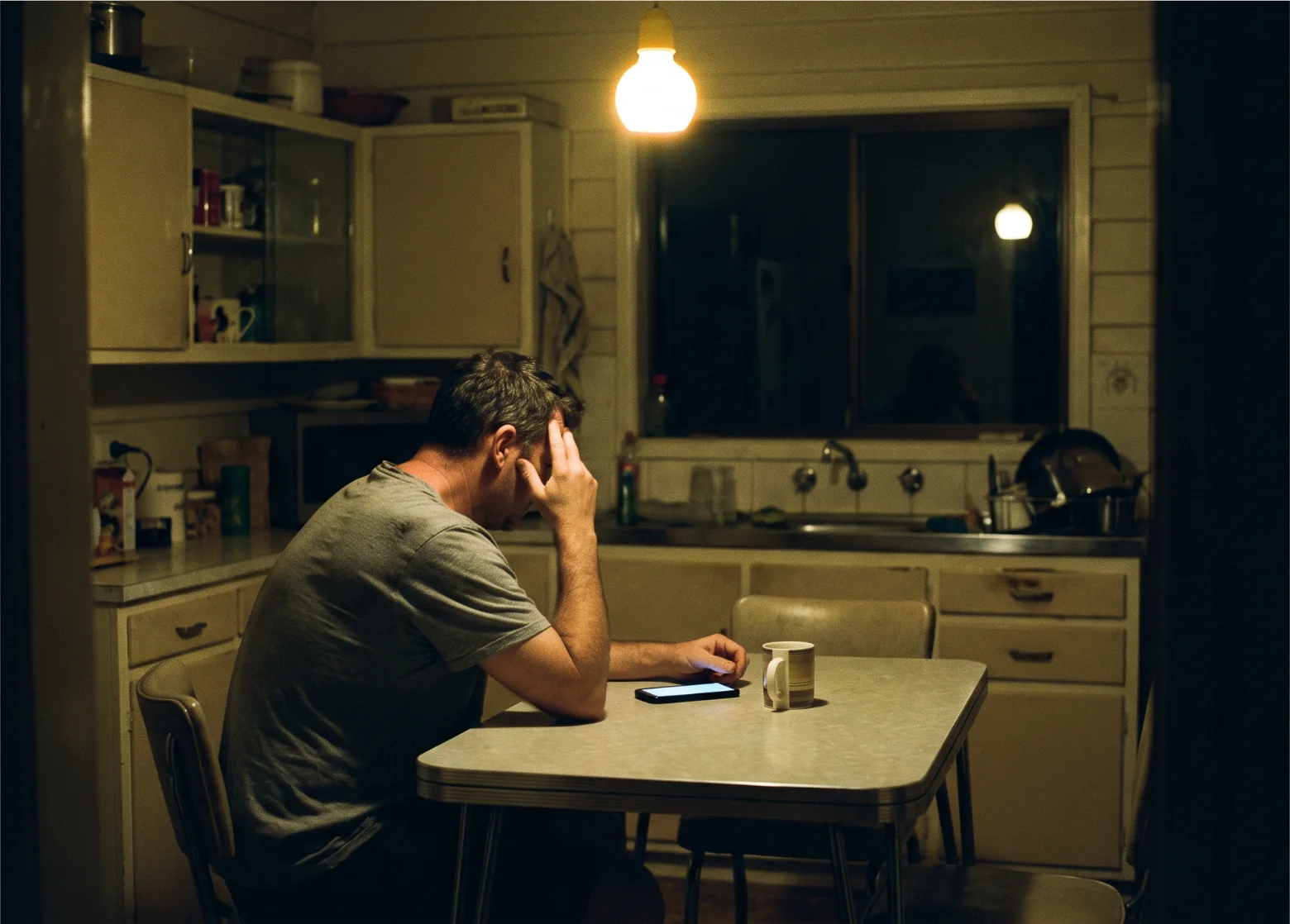
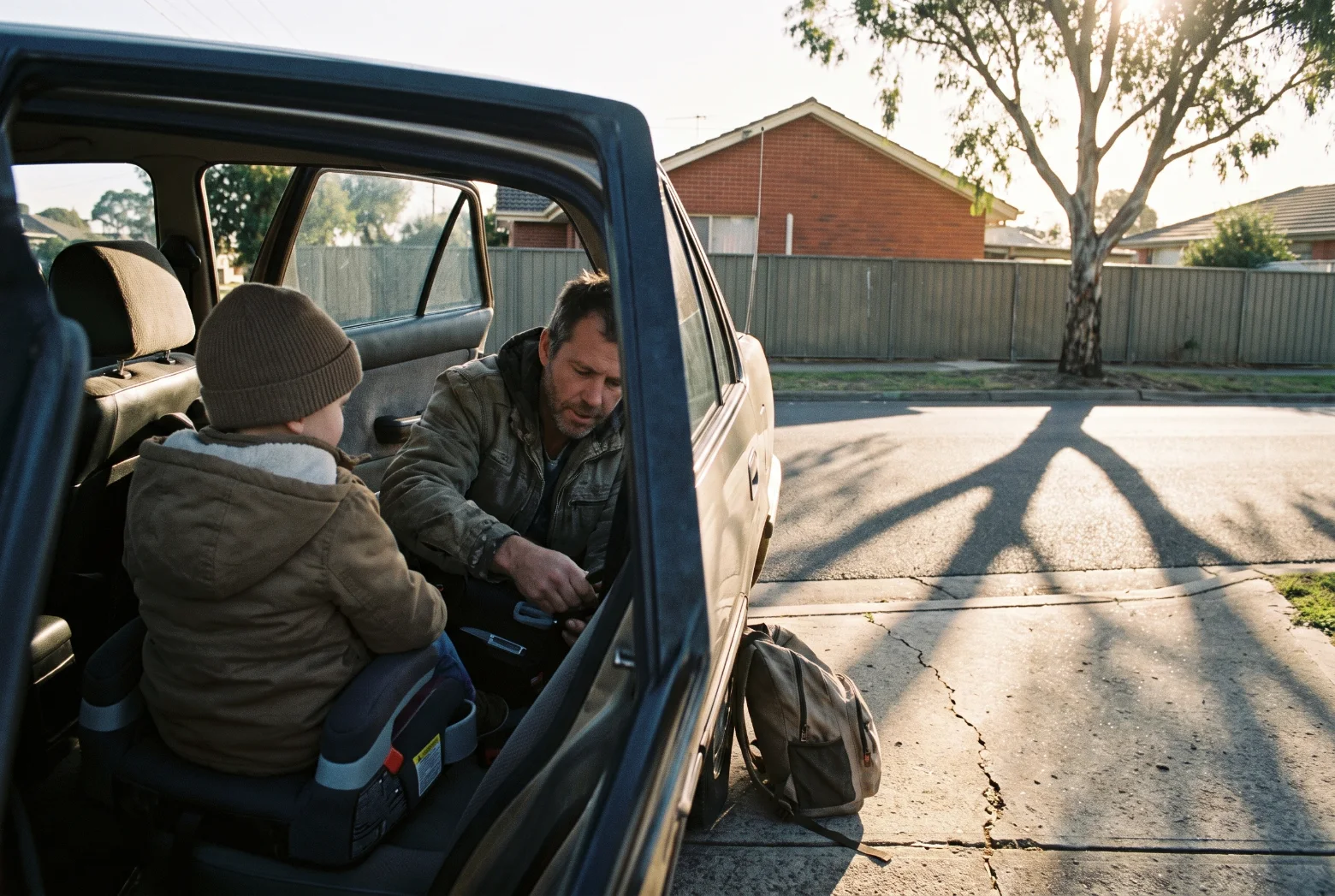
The photography is generated concept imagery, made for this document with an image model and labelled as such on every plate. No frame is a photograph of a real user, a real client or a real member of the team, and none should be reproduced as though it were. The scenes are chosen to carry the subject honestly – no faces of children, nobody performing distress for a camera – and they illustrate the argument rather than evidencing it.
Enquiries. to confirm – contact name, email and entity. This document remains confidential and is not to be reproduced or circulated without written consent.